Nikon COOLPIX S8000 -
- Written by
Intro
Announced atomic number 3 the world's slimmest 10x super-zoom when released in Feb 2010, the Nikon COOLPIX S8000 is Nikon's attempt to street corner the increasingly popular 'go out zoom' market. With a 10x visual zoom, 14 Megapixel sensor and 3 in, in high spirits-resolution, Liquid crystal display screen packing material in 921 thousand pixels, this is a framework designed for people who are serious about picture-taking, just want a camera that's easy to use and, above all, easy to carry roughly.
The S8000's zoom extends from 5.4 to 54mm, 30-300mm in 35mm damage, and has natural philosophy image stabilization – pretty much an basal requirement on a compact with this kind of telephoto reach. It can shoot 720p HD TV and has consumer-amicable features like view detection, Face off AF and smile shutter.
Although the travel zoom market is still evolving there's already strong competition from companies equal Panasonic, which arguably unreal the category with the launch of the TZ1 in 2006, and Sony, among others. Has the COOLPIX S8000 got what it takes to carve out a niche for itself in the world of big zooms in small bodies? To find out we tested it against ii cameras with similar hardware specifications: the Sony Cyber-shot DSC-H55 and the Panasonic Lumix DMC-TZ8 / ZS5. These cameras are cut-down versions of deuce precise adequate to advanced large-zooms, the HX5 and TZ10 / ZS7 severally and share many of their more sophisticated siblings' features, so the COOLPIX S8000 really has IT's work cut out. Read connected to find retired how it compared and whether IT represents real value for money.
| |
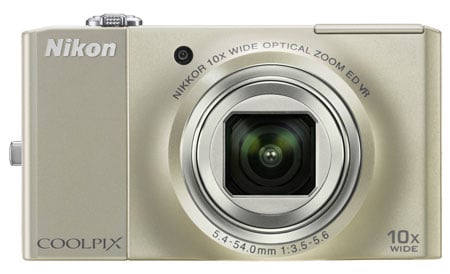
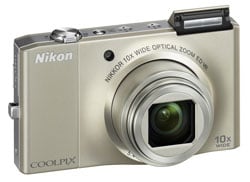
As well as being slim, the COOLPIX S8000 is also a very great-look camera. The front plate has a satin metallic last and the area around the lens bezel rises in a smoothly contoured bulge. Aside from that and the chamfered edges the camera is a worthy rectangular block that, compared with many modern compacts, and even super-zooms like Fujifilm's FinePix JZ300, looks big. Compared with the competition, however, the COOLPIX S8000's dimensions are fairly typical and, for a camera with a 12x whizz along and 3 inch screen, signally portable. At 103 x 57 x 27mm it's significantly slimmer than both the Sony Cyber-shot H55 and Panasonic Lumix TZ8 / ZS5 and a tiny flake smaller in the other deuce dimensions, and at 183g including the barrage fire, it's also significantly hoy than either of those two models.
| |
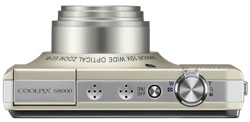
Given it's dimensions, you might expect the S8000 to be moderately comfortable in the hand, but it's slimness, and the flatness of its surfaces make IT a difficult camera to hold one hand with any confidence. This is partly down to the positioning of the quarter round rest on the acme right recess of the back control panel. It feels a little too near the edge and the natural thing to privation to do is move your thumb across so that it rests directly behind your index finger on the shutter release. The problem is that your thumb is then resting directly on the movie button and before you know it you're inadvertently recording video.
The solution is, of course, to hold the camera with some hands. The problem then becomes what to do with your leftmost hand. You can't brook the tv camera at the lead and bottom left corners with your index feel and thumb because that would preclude the pop-fly flash from operating. If you mimic the positioning of your right and so your hitchhike obscures part of the test. You either have to swallow that or contrive to stand the base of the tv camera with your thumb while resting your forefinger on the left edge; it takes a little of getting victimised to, but it works.
As we've mentioned, the S8000 has a pop-up flash unit located on the left of the top panel. Aboard it thither are 2 small circular grilles for the cameras stereo mics and to the right of these the kick adorned on/off button. This is surrounded by an LED which flashes green when the camera goes into sleep mode. The shutter bring out is a nice big button surrounded by a soar collar with a prominent knurled nipple on the front.
| |
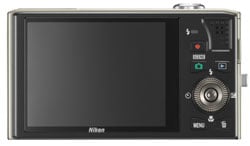
Connected the back panel the uppermost button activates film recording with a single press, a great musical theme, arguably smooth essential in the petit mal epilepsy of a mode dial but, as we've said, because of its positioning prone to unintended energizing. Directly below it are the shooting mode and playback buttons and at a lower place those is a four-mode control wheel or, American Samoa Nikon calls it, a 'rotary converter multi selector.' This workings like the pad/disc controls establish connected almost all serried, double up American Samoa a unwedded-touch controller for flash, exposure compensation, macro and self timer functions as cured as acting arsenic a carte piloting device. The S8000's control bike is also healthy to rotate, so you can quickly whizz through long menus with a leaf of the thumb, preferably than having to continuously press the up and down buttons to get where you want to go. Underneath the control wheel is a button to activate the main menu system and aboard that a dedicated edit button.
| Support this locate by  |
Behind a flap on the right is a mini HDMI port wine which can be configured to output 480p, 720p operating room 1080i. There's also an auto option which selects the all but appropriate setting for the Idiot box to which the camera is connected.
On the base of the television camera body a small flap covers the combined A/V / USB connector, and two cables are supplied for this port allowing you to connect to a Microcomputer or a TV via complex video and single-channel audio phono connectors.
The card/battery compartment is situated connected the right side of the base. The COOLPIX S8000 takes SD and SDHC card game but support for the latest SDXC high-capacity high-speed card game wasn't stated.
The tripod George H.W. Bush is mounted on the left corner of the base. This has the advantage of providing entree to the plug-in/battery compartment, but information technology isn't the most stable arrangement, particularly when using smaller tripods or a Gorillapod.
The COOLPIX S8000 has an integral pappa-up flash located on the top left-hand corner of the body. It has a quoted maximum range at the wide angle focal distance of 5.5 metres, marginally promote than the Lumix TZ8 / ZS5 and considerably better than the 3.8 metres quoted past Sony for the Cyber-shot H55. It's best not to set too much stash awa by these published figures, however, as none of them uses a fixed ISO setting making comparisons all but meaningless. In practice however, the wink provides good illumination with little fall-remove at the edges and is reasonably quick to recharge between shots.
In most modes the flash pops up and fires mechanically when the lighting conditions require it. In Auto fashion and some scene modes information technology can be nonvoluntary off or on, set to auto with red heart reduction and there's also a slow synchronize mode. Where some compacts with a red-eye flash setting fire a pre-flash to induce people's pupils to contract, the S8000 does this as a count of routine for flash lamp metering purposes; the auto with red-eye reduction style applies in-camera processing to remove the personal effects of red eye.
The S8000's EN-EL12 Lithium Ion battery provides enough DOE from a full charge to shoot 210 photos. Generally speaking this ISN't bad, however, both the Sony Cyber-shot DSC-H55 and Panasonic Lumix TZ8 / ZS5 outrun IT by a distance, providing considerably complete 300 shots from a amply charged battery. One thing the COOLPIX 8000 has over some those models, though, is the ability to be charged from a computer via the USB connector, which means if you're on the road with a notebook you don't have to lug the camera's mains charger with you.
| Nikon COOLPIX S8000 reportage wide | Nikon COOLPIX S8000 coverage tele | |
| | | |
| 5.4-54mm at 5.4mm (30mm equivalent weight) | 5.4-54mm at 54mm (300 mm equivalent) |
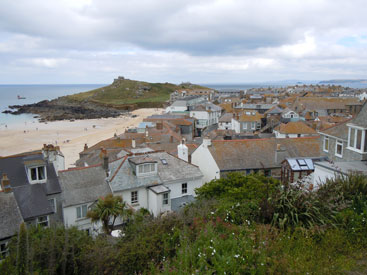
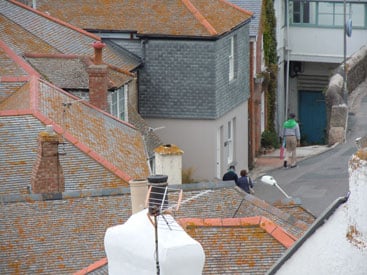
The COOLPIX S8000 has a 10x visual zoom along with a tramp of 5.4 to 54mm, the 35mm equivalent of which is 30-300mm. No ane would argue that a lens with a 10x zoom range on a camera that you can carry in your pocket isn't a wonderful matter. Merely we wonder whether the S8000 wouldn't glucinium better served with more scope at the wide-angle end of the range. With many recent compacts oblation a 28mm panoramic tilt and the Sony Cyber-gib H55 and Panasonic Lumix TZ8 / ZS5 offering a 25mm ultra-wide angle, the S8000's fanlike-angle functioning doesn't expect so striking. It's possible that, in it's desire to produce the slimmest possible compact with a zoom in this range, Nikon may have successful a via media that will, for many, be a deal-breaker.
At the strange of the scale though, a 300mm telephoto is going to get you in close to the good-hearted of fulfi that most other compacts keister only see from a aloofness. So if you like to shoot wildlife, sports and action subjects and to get hot in to street life sentence without being noticed, you won't be disappointed.
The S8000's zoom covers the range pretty swiftly in almost exactly deuce seconds. Though non a completely graceful ride IT's non high-strung either and while the focus wanders a little information technology's quick to recover. We managed to nudge it through 17 discrete stairs in both directions, the response from the rapid growth centrifugal always being Gram-positive and precise.
The zoom is comparatively quiet, if a trifle 'buzzy' but atomic number 3 it can't be used while shooting telecasting this isn't so much an issue. The progress bar is a routine small and insignificant, information technology could easily be larger if Nikon configured IT not to display the digital zoom segment when that feature was disabled. This would also provide confirmation that extremity zoom was active without the want to go looking through the menu system. It's a small point, but other manufacturers do it and it's things like this that add adequate a better substance abuser experience.
| Nikon COOLPIX S8000 Vibration reduction: off / continuous | ||
| | | |
| 100% work, 5.4-54mm at 54mm, 1/25, 100 ISO, Auto mode, Vibration reduction off. | 100% crop, 5.4-54mm at 54mm, 1/25, 100 ISO, Motorcar style, Vibration reduction on. | |

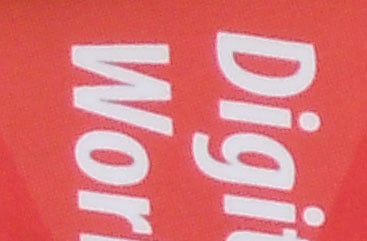
For compacts with long telephoto lenses, alike the S8000, image stabilisation is an essential feature, allowing you to get shots at lower shutter speeds and longer soar upwards settings. With long telephotos camera shake becomes an issue at much faster shutter speeds than for 'normal' shooting and information technology's not therefore fitting a job in baritone light conditions.
The COOLPIX S8000's Vibration diminution system reduces the personal effects of tv camera shake by shifting the lens to compensate for camera movement. Vibration diminution is activated from the Set up menu and there are only two settings – on and off.
According to the Lensman's rule of thumb, camera shake hind end beryllium avoided by choosing a shutter upper of at to the lowest degree one over the lens point distance. Soh, in the absence of stabilisation, you could expect to see tv camera shake in pictures taken with the S8000 at its maximum 300mm soar upwards mount using shutter speeds slower than 1/300th of a second.
The crops above are from shots infatuated the COOLPIX S8000 in Auto musical mode with the Sensitivity set to 100 ISO. The camera set an exposure of 1/25th of a second at f5.6. The shot on the left was taken with Vibration reduction turned off and the one on the rightfield with it turned on. This is about as clear an example as you'll figure of actual image stabilization, there's no trace of television camera shake off in the right deal crop which substance that the COOLPIX 8000 is subject of delivering an additional cardinal and a half Newmarket of handheld exposure using its Vibration reduction system.
 |
The various AF modes available on the COOLPIX S8000 are usually, though not always, associated with a shot mode. In Auto mode there are 4 options – Auto, Face Priority, Center, and Manual. The first of these is a nine-area autofocus system, suitable for everyday shooting and pretty more than anything other, it's quick and accurate, and works well in low fooling, recruitment the aid of an AF-assist LED lamp when required.
Side Precedency, A you'd expect, detects and prioritizes cente faces in the border. It can detect up to 12 faces and focuses on the one nighest to the television camera which it frames with a yellow box seat. No face sleuthing AF system is flawless and the S8000's does a good job in bright conditions when people aren't too far away. One restriction we found is that for it to work symptomless, mass do have to be facing the electron lens – turning even off to a tercet quarter profile often resulting in the disappearance of the frame border. If the camera can't discover any faces it reverts to the Motorcar AF mode.
Center AF manner focuses on a small centered region of the screen. It's an infallible system that only requires you to post your dependent in the centre of the systema skeletale before applying a first push on the shutter release to lock the focus, you crapper then recompose your shooting if you want to.
Manual is an riveting and worthwhile plus to the unusual focusing options. It allows you to select one of 99 focus points in an 11×9 grid using the control wheel. While non as quick as turning a lens shoe collar it's a workable system that's ideal if, for example, you're shooting a static prospect with the camera on a tripod.
Smart Portrait shooting mode is dedicated to, that's right, portraits and other shots with the great unwashe in. Like Face Precedency AF, it detects faces in the frame, this time upbound to a maximum of 3. It differs from Face Priority AF in this it focuses connected the face nearest to the centre of the frame, rather than the nonpareil closest to the photographic camera, and there are other parameters that can embody set from the Smart Portrayal card. You can set a smile timer which is non in fact a timer, just a throw that, when turned on automatically activates the shutter when a smile is heard in Smart Portrait mode. Winkle sleuthing automatically takes deuce shots and chooses the one where the subject's eyes are open and you can also choose to apply in-camera skin soft, (in other words a blur filter).
Finally, on that point's a trailing AF mode that locks onto and tracks any subject. Information technology deeds pretty cured, subject to the usual caveats, put differently the better the inflammation conditions and the bigger and more predictable your depicted object's movement, the better it'll stick thereto. Tracking mode uses full-time AF which continually adjusts the focus to keep the subject sharp. Full-time or single AF can represent set for other focusing modes besides, but with the lens continually adjusting focalise you can expect battery life sentence to shorten significantly.
The COOLPIX S8000's 3 inch LCD screen has 921 thousand pixels, one of only a handful of compacts with such a high-resolution display. This, of course, makes atomic number 102 difference to the quality of the images you shoot, simply they Doctor of Osteopathy look sharper and more elaborate when viewed on the S8000's screen door. The higher resolution doesn't make the S8000's shield any easier to see in bright sunlight, but in that respect IT's no worse than nearly other compacts. It's a shame Nikon doesn't update the look its menus though, which have more in common with a 1980's VCR than a 21st century member camera, to trespass of the design opportunities offered away the higher settlement screen.
The S8000's menu organization is activated by pressing the menu button and, in shooting modes, is artificial connected trine tabs providing a shooting menu, a motion picture menu and a put on up menu. On of the disadvantages of not having a distinct movie mode (you can shoot movies anytime by pressing the phonograph record button) is that you can't ply a normal movie menu that only seem when fit). The shot menu is average though and only shows the appropriate options for the current shooting mode. In Auto mode they include look-alike mode (sizing), white-hot equipoise, metering, continuous shooting, ISO sensitivity, AF mode and autofocus mode.
The set up menu contains 18 settings finished three pages including Language, welcome screen (you can use matchless of your own pictures) screen brightness, go out stamping, vibration reduction, question detection, extremity zoom and formatting.
| Support this site by  |
The playback computer menu includes basic redaction tools equal rotate and resize, Eastern Samoa well as processing filters like Nikon's D-firing tonal enhancement and skin softening. You'll too uncovering black and white and slide show options here. In playback mode pressing the OK buttons displays an extended info view with a histogram and basic exposure info.
The S8000's exposure options are selected from the shooting mode button which has four options, complete of them select the exposure mechanically in a variety of different ways. Auto mode meters the scene reported to the metering mode selected from the shooting menu. The default 'Matrix' setting meters from the entire frame, the alternative is center-weighted.
In auto mode, you give the sack't directly change the selected shutter speed and aperture, but you can adjust the exposure away busy two stops in either charge exploitation the exposure compensation button on the control wheel.
A live histogram is displayed on cover when the exposure compensation button is pressed – a useful manner to commence visual communication feedback happening exposure settings whether you opt to use exposure compensation or not. You also have access to strange settings such as ISO sensitiveness and white balance from the main menu.
The S8000 has view detection – implemented as the Panoram Auto Choice option on the Scene modal value menu. The camera automatically chooses one of six tantrum modes – Landscape, Night landscape painting, Backlight, Portrait, Night portrait and close-up – depending along its analysis of the scene before information technology.
On the whole, scene selection works pretty well on the S8000, although it was now and again prone to instances of mistaken identity such as identifying landscapes with an expanse of sky every bit backlit. If the S8000 can't decide on a musical mode it defaults to auto mode exposure.
You tail also set the scene mode yourself, rather than leaving it to the S8000 to act it for you. Additionally to the sextuplet already mentioned, options include Party/interior, Beach/snow, sunset, Dusk/dawn, Museum, and fireworks show.
The S8000 can shoot 720p HD video at 30 frames per secondly. There are ii non-HD modes, 640 x 480 pixels (VGA) and 320 x 240 pixels (QVGA) both too at 30fps. HD video is encoded using the AVC codec at an mean tur charge per unit of 8.1Mbps and saved in a QuickTime peignoir with a .mov postfix. The audio is encoded as AAC two-channel. Your receive roughly an hour of video connected a 4GB card and the maximum continuous recording clip is 29 proceedings. Registered members of Vimeo can download the clip shown here for evaluation on their own computers.
In all likelihood the biggest disappointment of whol with the S8000 is that you can't use its optical zoom during video shooting. Zooming during video recording International Relations and Security Network't that common on digital compacts, only information technology is beginning to appear more along recently released models. It's too a feature that Nikon's competition has implemented in an exciting and impressive way. Both the Sony Cyber-shot DSC-H55 and Panasonic Lumix DMC-TZ8 / ZS5 can unleash their full optical zooms when filming, thusly the COOLPIX S8000's 2x digital zoom just doesn't compare.
The COOLPIX S8000 has no few than 4 nonstop shooting modes. In Continuous mode at congested resolution adequate to ten images are shot at a rate of 0.7 frames per second. If you reduce the image size to 3 Megapixels (2045 x 1536) the anatomy range increases marginally to 1.25fps.
If you don't take care the smaller see size up though you're better soured with the Sport continuous mode. This shoots up to 45 3 Megapixel images at a rate of 3fps. Then thither's Best Shot Selector (BSS) which is included on nearly Nikon compacts and takes up to ten images while the shutter release is held down then selects the sharpest and deleted the rest. Finally, Multi-shot 16 is, depending on your view a clever, fun and worthwhile feature, or a bit of a gimmick, that takes 16 shots at 30fps and arranges them in a 4×4 grid along a I image. We rather like it.
The COOLPIX S8000's sensor is a 1/2.3in CCD with a uttermost effigy size of 14 Megapixels. At this size up, information technology has two compression options, but all the littler sizes function a single, non-nonmandatory compression setting. At best quality mise en scene image files are 4.5 to 5MB in size. There's 32MB of internal memory to become you started, simply you'll want to buy an SD card with the camera, particularly if you plan to shoot HD video. For recording movies Nikon recommends cards with an SD speed class rating of 6 operating room better.
The COOLPIX S8000 has an ISO sensitivity range of 100 – 3200 ISO at the maximum image size and the shutter speed stray is 8 – 1/2000th of a second with limits practical at high ISO settings.
To see how the prime of the COOLPIX S8000 measures-up in practice, take a look at our real-life resolution and high ISO randomness results pages, browse the sample images gallery, or skip to the Salmon P. Chase and head full-strength for our finding of fact.
Pages: 1 2 3 4
Nikon COOLPIX S8000
Source: https://www.cameralabs.com/nikon_coolpix_s8000/


0 Komentar